 Englisch
 Slovak
 German


Cleaning fiber optic connectors
A contaminated connector is a common cause of high insertion loss, increased reflections and unstable connections. A significant share of problems in fiber optic installations are caused by contaminated connectors. Even a very small amount of contamination can affect the transmission of light.
It is easy to assume that a new fiber patch cord is clean when the protective cap is removed. However, this is not necessarily the case. A connector can become contaminated during manufacturing, packaging, transportation or handling. The protective cap itself may also contain dust or residues from the manufacturing process.
For this reason, new and factory-terminated connectors should also be inspected and, if necessary, cleaned before they are connected. The same applies to connectors that have previously been in use. A connector that is disconnected from a patch panel or active equipment should not automatically be considered clean when it is reconnected.
Inspection and proper cleaning of fiber optic connectors should therefore be a standard part of the installation process before connectors are mated.
Foss recommends:
- Inspect with a fiber microscope
- Dry clean if necessary
- Inspect again
- Wet clean if necessary
- Inspect again
- Connect
Inspection with a fiber microscope
A good working practice in the fiber optic industry is to inspect connectors before mating them. The principle is simple: inspect the connector end face before connection. If it is contaminated, clean it and inspect it again. Only connect the fibers when both connector end faces are clean.
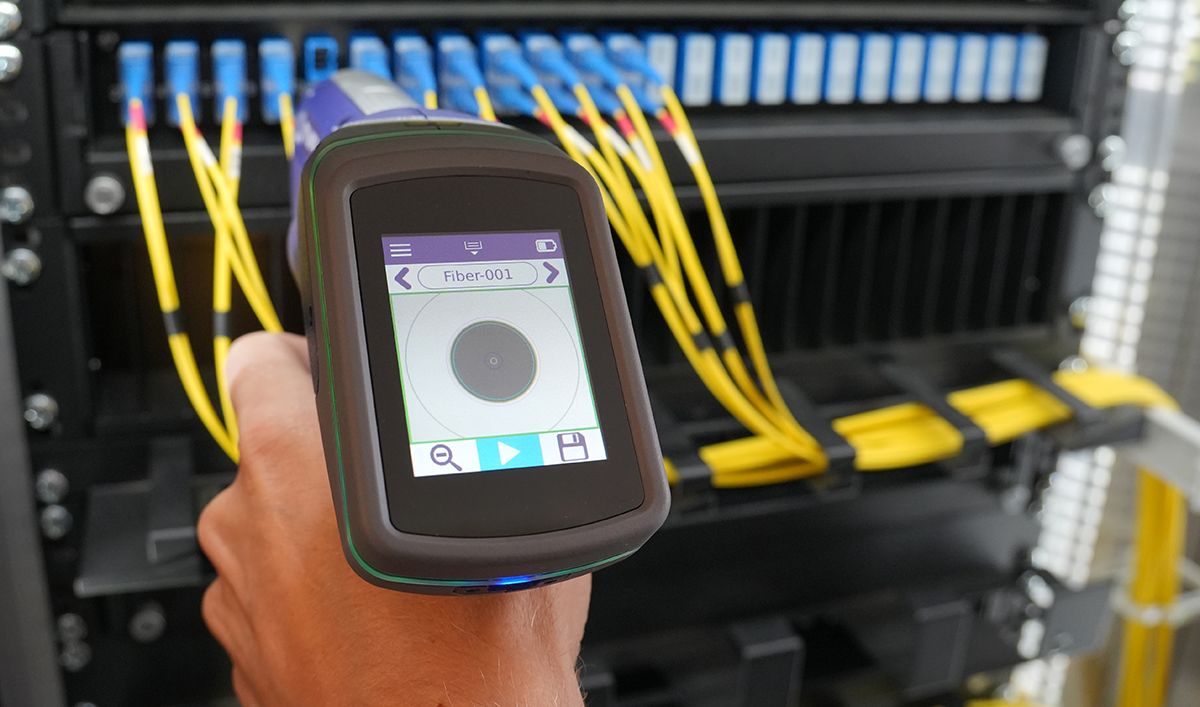
A fiber inspection microscope makes it possible to examine the connector end face and identify contamination that cannot be seen with the naked eye. With automated inspection, the connector end face can be evaluated according to the criteria defined in IEC 61300-3-35, the international standard for visual inspection of fiber optic connector end faces.
If the inspection shows that the connector end face is already clean, there is no need to clean it.
A good routine is therefore:

Want to learn more about fiber connector inspection?
Our supplier VIAVI has created a introduction to fiber inspection, explaining why inspection is important and which methods are used to ensure clean and reliable fiber connections.
Read VIAVI's article: What is Fiber Inspection?


A contaminated connector can contaminate a clean one
One important reason for inspecting connectors before mating them is that contamination can be transferred from one connector end face to another.
If a contaminated connector is inserted into a clean adapter or transceiver, contamination can transfer to the other connector end face. Instead of having one contaminated connector, both sides may then require cleaning.
When two fiber optic connectors are mated, the connector end faces make physical contact. Because this contact occurs across a very small surface area and the ferrules are spring-loaded, particles trapped between the end faces can be subjected to considerable pressure. In the worst case, hard particles can cause scratches or permanent damage to the connector end face. If this happens, cleaning the connector afterwards may not be enough to restore its performance.
Always make sure that both connector end faces are clean before mating.

The example shown here, illustrates finger grease on one connector before mating. After the connectors have been mated and inspected again, the physical contact area is clearly visible, along with the transfer of contamination to the previously clean connector.
Using the correct cleaning method
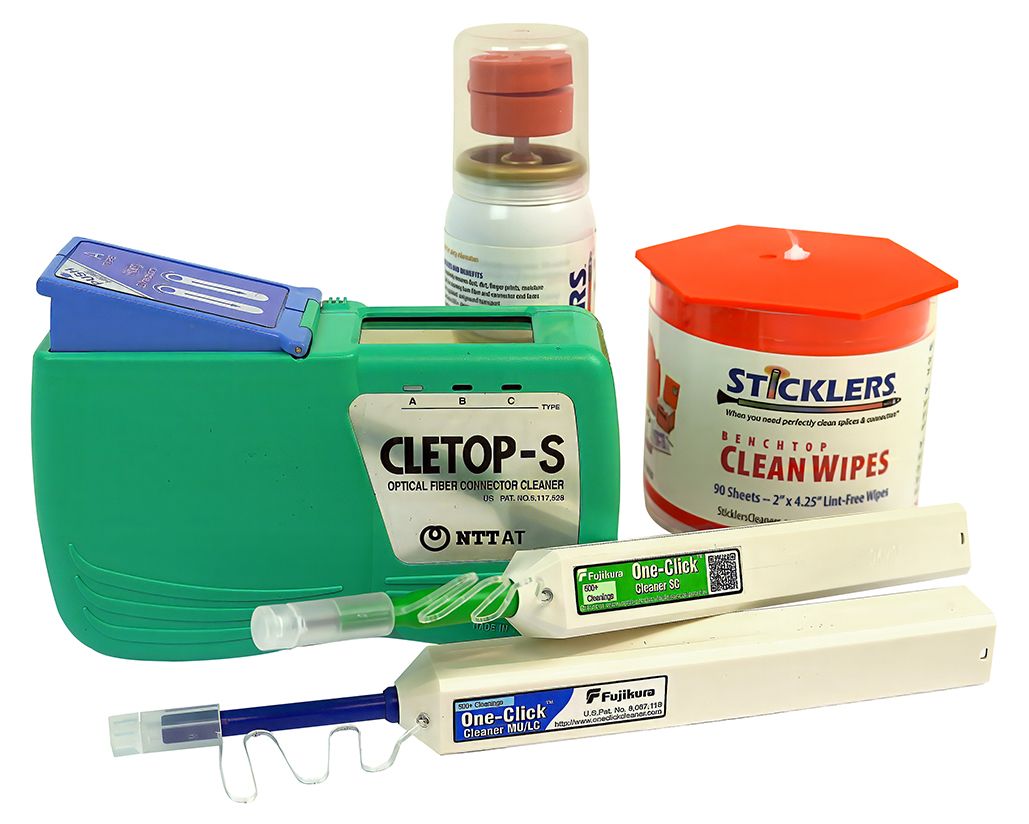
Different cleaning tools are available depending on the connector and adapter type. For common LC and SC connectors, one-click cleaners provide a fast and practical solution for field use. Special cleaning tools may be required for MPO and other multifiber connectors.
One-click cleaners can be used both on exposed connector end faces and on connectors located inside adapters. Cleaning cassettes are preferable when cleaning accessible connector end faces, as they clean a larger area of the end face compared with a one-click cleaner.
It is important to use products specifically designed for fiber optics. Ordinary paper, cloths or unsuitable cleaning agents can leave lint, particles or additional contamination on the connector end face.
Dry cleaning
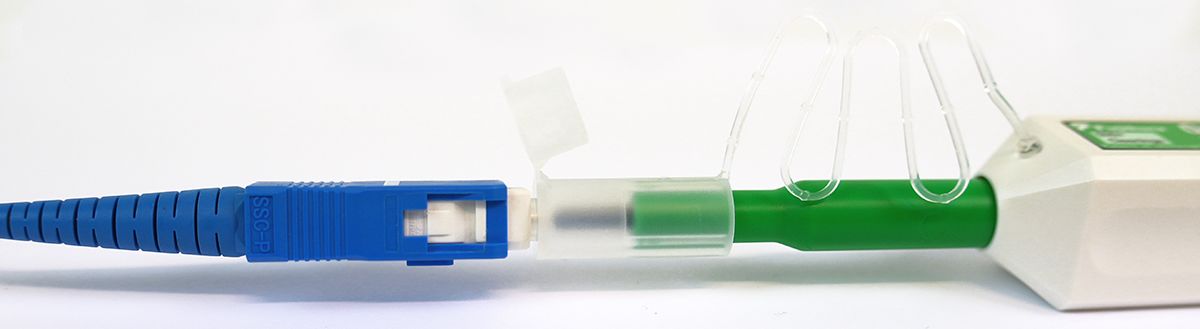
Dry cleaning should be the first choice when cleaning fiber optic connectors.
A one-click cleaner, cleaning cassette or other suitable dry-cleaning tool quickly removes ordinary dust and loose particles without leaving liquid on the connector end face. The method is simple to use in the field and is sufficient in most cases where the contamination consists of dust or other dry particles.
For new patch cords, dry cleaning should normally be sufficient.


One-click cleaners are used to clean the end face of fiber optic connectors. Manual cleaning sticks must not be used to clean the connector end face. They can pick up contamination from the guide sleeve inside the adapter and transfer it to the end face, where it may be rubbed across the surface.
Manual cleaning sticks are intended for cleaning the guide sleeve inside the adapter. This cleaning must be carried out with no connector connected, as shown below.

Wet cleaning
Wet cleaning is used when dry cleaning alone is not sufficient to remove contamination. This may be necessary for oil, grease or other persistent contamination on the connector end face.
In these cases, a small amount of cleaning fluid, specifically designed for fiber optics is used together with a lint-free cleaning material. The cleaning fluid helps dissolve the contamination so that it can be removed from the connector surface.
It is important not to leave the connector end face wet after cleaning, as this can result in drying marks or residues. Wet cleaning should therefore always be followed by dry cleaning.
When using a cleaning cassette, the cleaning tape can be moistened with fiber optic cleaning fluid. The connector is first cleaned on the damp tape. A fresh, dry section of the cleaning tape is then exposed, and the connector is cleaned again to remove any remaining fluid and prevent drying marks on the connector end face.
Wet cleaning a connector while it is installed inside an adapter can be difficult. If wet cleaning is necessary, the connector must be removed from the adapter before cleaning.


The Right Tools Make the Job Easier
Foss offers a wide range of cleaning products and tools for fiber optic connectors, suitable for both installation and maintenance in the field. The range includes solutions for different connector types and applications, helping technicians have the correct cleaning equipment available when establishing a fiber connection.
A good cleaning routine requires very little time and relatively simple equipment, but it can make a significant difference to the quality and reliability of the completed installation.
Explore our range of fiber optic cleaning products and find the right tools for your installation.