 English
 Slovak
 German


FIBER OPTIC
SPOOLS FOR
DRONES AND UGVs:
Reliable communication is one of the fundamental challenges in remotely operated systems. Drones, unmanned ground vehicles (UGVs) and robotic platforms typically depend on radio-frequency (RF) links to transmit video, sensor data and control signals.

But what happens when radio communication becomes unreliable or unavailable?
Increasingly, fiber optics are providing an alternative. Lightweight fiber-optic spools can establish a physical data connection between an unmanned vehicle and its operator, maintaining high-bandwidth communication in environments where wireless technologies face interference, signal loss or other limitations.
The technology has gained considerable attention through its use in FPV drones, but its potential extends far beyond this application.
How fiber optic communication works
in FPV drones
A conventional FPV drone communicates with its operator using radio signals. Video is transmitted from the drone while control commands travel in the opposite direction.
A fiber-connected system takes a different approach. The drone carries a compact spool containing a long length of lightweight optical fiber. As the drone moves, the fiber pays out from the spool, creating a direct optical communication path between the platform and its operator.
Control signals and high-bandwidth video can then be transmitted through the fiber rather than through the surrounding RF environment. Fiber systems can provide high-speed, low-latency data transmission while remaining unaffected by RF interference affecting conventional wireless links.
This fundamental difference creates several interesting technical advantages.
Communication independent of radio frequencies
One of the most significant characteristics of a fiber optic link is that the data is transmitted as light through the fiber rather than as radio waves through the air.
As a result, RF interference and RF jamming that can disrupt conventional wireless communication do not directly affect the optical data link. This makes fiber particularly interesting in RF-congested environments and locations where wireless communication is difficult or unreliable.
High-bandwidth video and data
Optical fiber is designed to transport large amounts of data with low signal loss. For remotely operated vehicles, this can provide a stable connection for high-quality video, sensor information and control data. Reliable visual feedback can be especially important when platforms are operating in confined, obstructed or technically challenging environments.
Communication beyond radio line of sight
Wireless communication is heavily influenced by the surrounding environment. Buildings, underground structures and other obstacles can weaken or block radio signals.
A deployed optical fiber creates a physical communications path instead. This opens interesting possibilities for unmanned systems operating inside buildings, tunnels, mines, industrial facilities and other locations where conventional wireless communication may be unreliable.
The engineering challenge:
Range, Weight
and Reliability
The concept may sound simple, but designing a practical fiber optic spool for a mobile platform requires careful engineering. The fiber must be lightweight enough to avoid significantly restricting the platform while remaining capable of being deployed reliably during movement.
Longer fiber means longer potential operating distances, but also additional weight. The spool itself becomes part of the vehicle's payload, affecting factors including available payload capacity and battery consumption.
There are also mechanical considerations. Unlike a wireless link, the fiber creates a physical connection. The cable can potentially be damaged, severed or caught on obstacles, meaning spool design and controlled fiber payout become important parts of the overall system.
The engineering challenge is therefore a balance between several factors:
- fiber length
- spool size and weight
- mechanical reliability
- fiber handling
- platform payload
- power consumption
- required data capacity
Optimizing these parameters is essential when designing fiber solutions for small drones and unmanned ground vehicles.
Beyond drones:
Fiber-connected UGVs
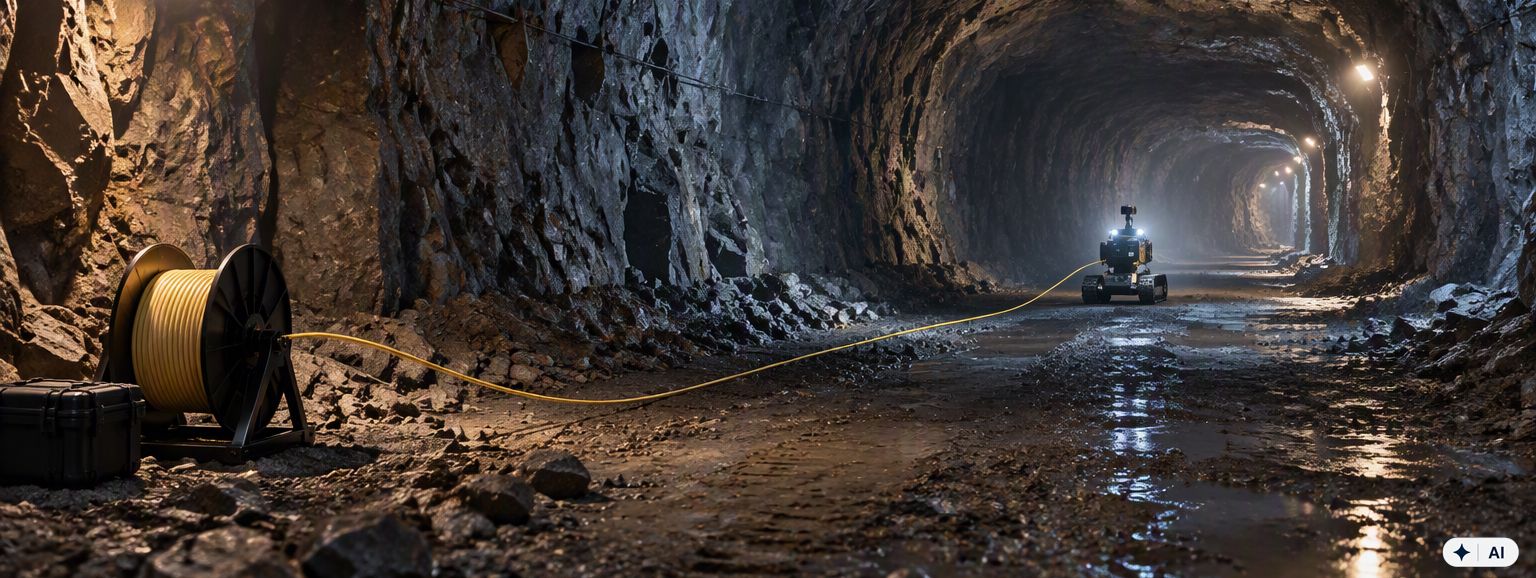
The same principle is highly relevant for unmanned ground vehicles. UGVs are increasingly used to inspect or access places that are difficult, dangerous or impossible for people to enter. Maintaining communication with those vehicles can be challenging when concrete structures, underground environments or electromagnetic interference prevent reliable wireless transmission.
A compact fiber optic spool can provide a continuous communication path as the vehicle moves deeper into the environment. That makes the technology particularly relevant to applications where communication reliability is more important than complete freedom from a physical connection.
Potential civilian applications
Although recent developments have brought significant attention to fiber-connected FPV drones, the underlying technology has much broader potential.
Mines and underground infrastructure
Underground environments present particularly difficult conditions for wireless communication. Drones or UGVs equipped with fiber optic spools could provide video and sensor data from tunnels, mines and other underground structures while maintaining communication with operators outside the affected area.
Search and rescue
Following accidents, structural collapses or other emergencies, rescuers may need information from areas that are unsafe for people to enter.
Remotely operated vehicles can carry cameras, thermal imaging equipment and environmental sensors into these environments. A fiber connection provides an alternative communication channel when the surrounding infrastructure or RF environment makes wireless communication unreliable.
Industrial inspection
Large industrial installations can contain steel structures, reinforced concrete, machinery and electromagnetic equipment that make wireless connectivity difficult.
Fiber-connected robotic platforms could therefore have applications in inspection and monitoring tasks where a stable data connection is essential.
Fiber as an enabling technology for
unmanned systems
Fiber optic spool systems represent an interesting intersection between established optical communication technology and rapidly developing unmanned platforms.
The basic principle is straightforward: replace an uncertain wireless communication path with a physical optical connection.
The engineering challenge is considerably more complex. Fiber diameter, mechanical strength, spool design, weight, deployment characteristics and optical performance all have to work together in a compact system capable of operating while the platform is moving.
For both drones and UGVs, continued development of lightweight fiber and compact spool systems could expand the environments in which remotely operated systems can maintain reliable, high-bandwidth communication.
And that is perhaps the most interesting aspect of the technology: the optical fiber itself is well established, but the way it is being deployed is creating entirely new applications.