 English
 Slovak
 German



A revolution in tactical communications:
Why the modern battlefield relies on fiber
Modern military operations are undergoing a fundamental transformation. The widespread use of electronic warfare (EW) and continuous surveillance by unmanned systems place increasing demands on reliable and secure communication. Traditional radio communication can be vulnerable to detection, interference and jamming, making tactical fiber optic solutions an increasingly important part of modern defence infrastructure.
Key advantages of fiber optics in combat conditions
Fiber optic communication offers several important advantages for military operations, particularly in environments where reliable data transmission is critical.
Immunity to electronic warfare (EW) interference
Fiber optic cables are immune to electromagnetic interference and cannot be jammed by conventional radio-frequency jammers. This makes them a reliable alternative in environments where electronic warfare can disrupt wireless communication.
Radio silence and reduced risk of detection
Unlike radio communication, fiber optic connections do not transmit radio-frequency signals. This allows communication and data transfer without generating radio emissions that could be detected and used to locate equipment or positions.
High-speed data transmission
High-resolution video, radar information and real-time command data require substantial transmission capacity. Fiber optics provide high bandwidth and low latency, supporting reliable communication between critical systems and equipment.
Lightweight and durable construction
Modern tactical fiber optic cables are designed for demanding field conditions. Ruggedized cable jackets and connector technologies, including Expanded Beam connectors, provide enhanced resistance to mechanical stress, moisture, dust and repeated handling. Depending on their construction, tactical cables can also be designed to withstand heavy loads and vehicle traffic.
Practical battlefield applications
Tactical fiber optic solutions are used in a wide range of military applications, from command posts to frontline operations.
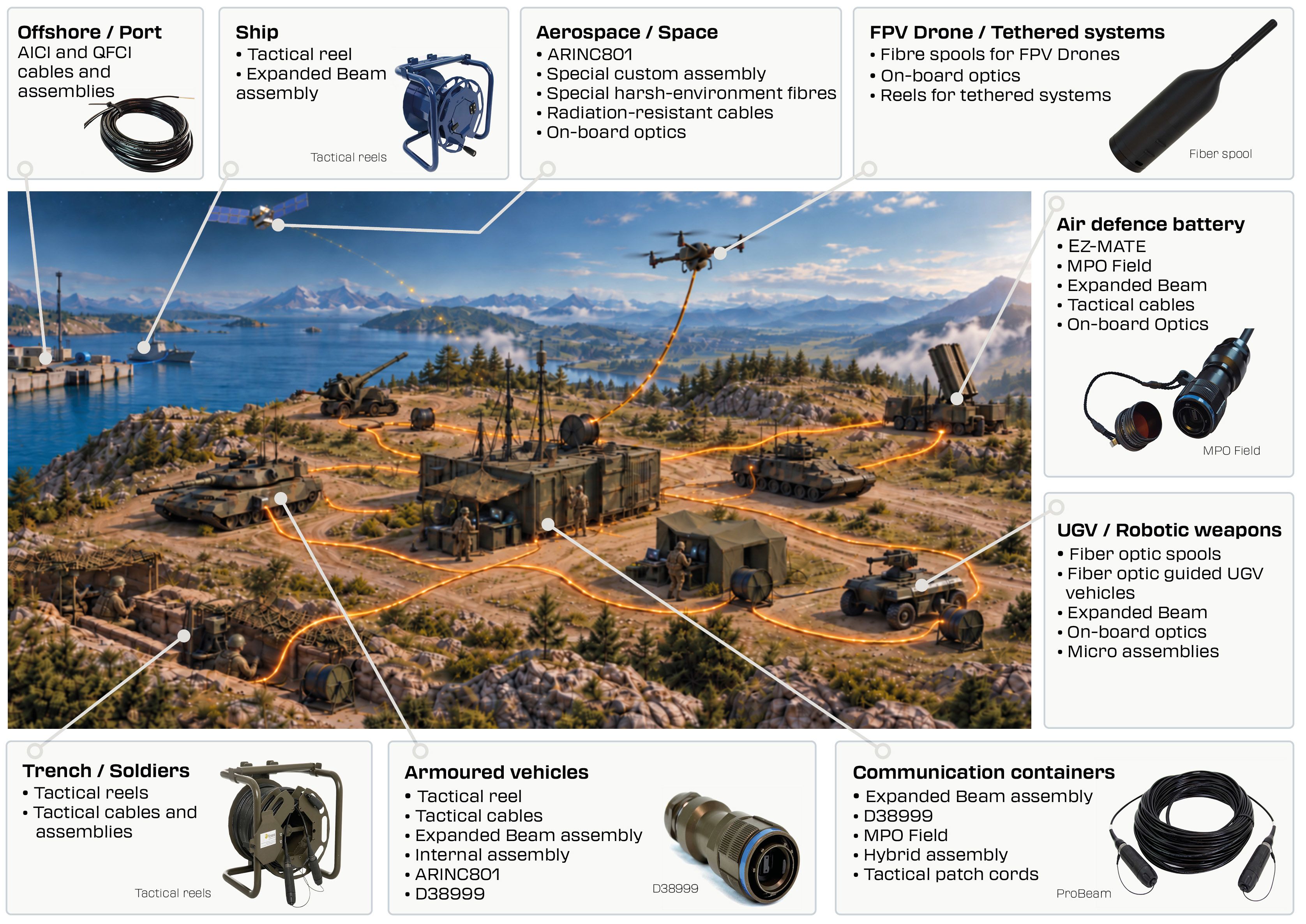
FPV drones and robotics
Fiber optic communication is increasingly used in unmanned systems operating in environments with extensive radio-frequency jamming. Fiber-tethered drones, for example, can maintain communication through a cable deployed during flight, reducing their dependence on radio-based control links.
Command posts and tactical operations centers (TOC)
Fiber optic networks provide high-speed connections between command posts, communication equipment and other critical infrastructure. These connections support reliable data exchange without radio-frequency emissions, while additional security measures can protect sensitive information.
Combat vehicles and air defence
Fiber optic cables can connect sensors, radar equipment, communication systems and other military assets. Their high bandwidth and resistance to electromagnetic interference make them suitable for demanding environments where reliable data transmission is essential.
The future of tactical communication
Fiber optics are becoming an increasingly important part of modern military communication infrastructure. The combination of high bandwidth, resistance to electronic interference and reduced electromagnetic emissions makes tactical fiber optic solutions valuable in environments where conventional wireless communication may be limited or disrupted.
With ruggedized cables and connectors designed for demanding conditions, fiber optic networks can provide reliable communication across a wide range of defence applications.
Foss supplies tactical fiber optic cables, ruggedized connectors and customized cable assemblies for demanding environments. Contact us to learn more about our solutions for defence and tactical communication networks.