 English
  Slovak
  German

WHY FERRULE GEOMETRY MATTERS IN
FIBER OPTIC CONNECTORS

A guide to PC and APC connector performance, polishing quality and optical reliability.
Fiber optic connectors are among the most critical components in any optical network. While connector types such as SC, LC, FC and E2000 are widely recognized, the performance of a fiber connection depends on much more than the connector housing itself.
A key factor is the geometry of the ferrule. The ferrule end face determines how accurately two optical fibers meet when connectors are mated. Correct ferrule geometry helps reduce insertion loss, minimize back reflections and ensure long-term reliability in the optical link.
What is a ferrule?
The ferrule is the precision ceramic component located at the front of a fiber optic connector. Its main function is to hold and position the optical fiber accurately when two connectors are mated through an adapter.
The optical fiber itself is made of glass, typically silica glass. The ferrule surrounding and positioning the fiber is normally made of precision zirconia ceramic.
Most modern fiber optic connectors use zirconia ceramic ferrules with diameters of either 2.5 mm or 1.25 mm, depending on the connector type. The ferrule is manufactured to very tight tolerances, but the final polishing process is essential for achieving the required optical performance. Even small variations in polishing quality or ferrule geometry can affect how the fiber end faces contact each other. This may lead to increased insertion loss, higher back reflection or reduced mechanical durability over time.

Why ferrule geometry matters
When two fiber connectors are joined, the goal is to create stable physical contact between the fiber end faces. This contact must be precise, repeatable and mechanically reliable.
Even microscopic imperfections can influence optical performance. A poorly polished ferrule, incorrect fiber height or excessive apex offset can create air gaps, uneven contact pressure or misalignment at the fiber interface.
Three key geometry parameters are important for the connectors:
Radius of curvature
The ferrule end face is not polished completely flat. Instead, it is polished with a controlled spherical radius.
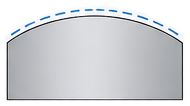
This curvature helps ensure that the two fiber end faces meet correctly when connectors are mated. A correct radius of curvature supports stable physical contact and helps reduce air gaps that could otherwise cause reflections and signal loss.
If the radius is outside the required limits, the connector may experience unstable contact, increased insertion loss or reduced long-term reliability.
Apex offset
The apex is the highest point of the polished ferrule end face. Apex offset describes the distance between this highest point and the ferrule or fiber axis.
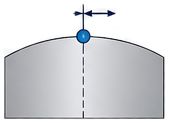
Ideally, the apex should be well centered. This helps ensure that the contact force between two mated connectors is distributed correctly around the fiber end face.
If the apex offset is too large, the physical contact point may move away from the center of the fiber. This can reduce contact stability and increase the risk of air gaps, back reflection, insertion loss and mechanical wear over time.
Fiber height (protrusion or undercut)
Fiber height describes the position of the fiber end face relative to the surrounding ferrule surface.
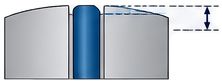
If the fiber protrudes too much from the ferrule, it may be exposed to excessive mechanical stress during mating. This can increase the risk of fiber damage or end-face wear. If the fiber is recessed too far below the ferrule surface, the connector may not achieve proper physical contact. This can lead to increased insertion loss and higher back reflection.
Correct fiber height is therefore essential for both optical performance and long-term durability.
PC and APC polishing
Fiber optic connectors are commonly polished using either PC or APC technology.
PC stands for Physical Contact. A PC-polished connector has a non-angled, slightly curved end face designed to create direct physical contact between the fiber end faces. This helps reduce back reflections compared with a flat or poorly polished surface.
PC connectors are widely used in optical networks where low insertion loss and stable performance are required. Depending on the product specification and application, PC connectors are required by international standards to achieve return loss values of 35 dB or better, but most connectors today (including Foss) achieve 45 dB or better.

APC stands for Angled Physical Contact. An APC connector has an angled end face, typically 8 degrees. This angle directs reflected light away from the fiber core and into the cladding, significantly reducing back reflection. APC connectors are commonly used in systems where reflections must be kept very low, such as PON, FTTH, long-distance links and other reflection-sensitive optical networks.
APC connectors commonly achieve return loss values of 60 dB or better, making them well suited for demanding optical applications.

PC and APC connectors must not be mated together. Even if the connector housing appears mechanically compatible, the different end-face geometries prevent correct physical contact. Mating PC and APC connectors can cause high insertion loss, increased reflection and permanent damage to the connector end faces.
Additional APC Geometry Parameters
For APC connectors, ferrule geometry is not only about radius of curvature, apex offset and fiber height. Two additional parameters are especially important: end-face angle and key error.
End-face angle
The APC end face is polished at a controlled angle, typically 8 degrees. This angle is what allows reflected light to be directed away from the fiber core. If the angle is not controlled correctly, the connector may not achieve the expected low back reflection performance. Accurate angle control is therefore essential for APC connector quality.
Key error
Key error describes the rotational alignment between the angled APC end face and the connector key. In an APC connector, the angled surface must be correctly oriented when two connectors are mated. If the key alignment is incorrect, the angled faces may not match properly. This can result in poor physical contact, increased insertion loss and higher reflection.
For this reason, key error is an important quality parameter in APC connector production and inspection.
Concentricity – the often overlooked parameter
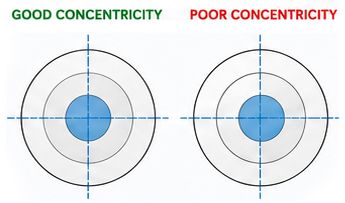
In addition to ferrule end-face geometry, concentricity is another critical factor in connector performance.Concentricity describes how accurately the fiber core is centered within the ferrule. If the fiber core is not properly centered, optical power can be lost at the connection point, even if the end-face geometry itself is within specification.
This is especially important in singlemode fiber, where the core is very small and alignment tolerances are tight.
For this reason, it is important to use high quality ferrules with low tolerance regarding hole diameter and concentricity.
Production
Advanced measurement systems are used during production and quality control to verify the above-mentioned parameters. These measurements help us ensure consistent low-loss performance across large production volumes.
Inspection and cleanliness
Correct ferrule geometry is essential, but it is not the only factor that determines connector performance. The connector end face must also be clean and free from scratches, dust, oil and other contamination.
Even a connector with excellent geometry can perform poorly if the end face is contaminated. Dirt or damage on the fiber end face can increase insertion loss, cause back reflection and, in some cases, permanently damage the connector when it is mated.
Inspection and cleaning should therefore be part of every professional fiber optic installation, production and maintenance process.
Quality geometry means better network performance
The quality of a fiber optic connection is determined by far more than the connector type alone. Proper ferrule geometry, accurate polishing, correct fiber height, low apex offset and precise fiber alignment all contribute to stable optical performance.
- For PC connectors, controlled physical contact helps ensure low insertion loss and reliable performance in standard optical networks.
- For APC connectors, the angled end-face geometry provides very low back reflection and is especially important in reflection-sensitive systems.
At Foss, we place strong emphasis on connector quality, polishing control and inspection to ensure that every assembled fiber optic solution meets the demanding requirements of modern communication networks.